Training in Systemic Body Therapy

Analysis of Systemic Character

THE Training in Systemic Body Therapy This is a course designed to train professionals who work directly in... human relationship to develop a more integrated, profound and accurate understanding of human beings.

Starting from the understanding that the character It is an adaptive organization built from childhood experiences, primary bonds, and the systemic contexts in which each person developed; this training teaches... identify how these patterns are inscribed in body, in breathing, in posture, in muscle tone, in the way of feeling, thinking, acting and relating.

Throughout the course, participants will be trained to perform passive and active body language reading, recognize character traits, understand unconscious emotional survival strategies, and integrate this reading into therapeutic, educational, organizational, and relational contexts.

A partnership:

About the Systemic Body Therapy Training

Presentation

There are conflicts that repeat themselves. There are symptoms that change form, but return. There are relational, emotional, and professional patterns that persist even when there is effort, awareness, and a desire for change.

This training program was created precisely to help professionals look beyond the symptom and get closer to the root cause.

The body is understood here as a living field of information, where the individual's emotional history, early traumas, systemic loyalties, and interrupted developmental movements are expressed.

Through Systemic Character Analysis, it becomes possible to access content that is often not available through verbal or cognitive means alone, allowing for faster, deeper diagnoses that are more aligned with the real causes of the problems presented.

This training is for those who wish to act with greater clarity, depth, ethics, and awareness.

Objectives

Throughout the training, the participant will:

  • Understanding the fundamentals of Systemic Character Analysis from an integrated perspective encompassing body, emotion, mind, and system.
  • To identify character traits and their patterns of functioning.
  • Recognizing bodily, emotional, and mental defense mechanisms.
  • Develop competence in passive and active body language reading.
  • Differentiate between functional and dysfunctional dimensions of character traits.
  • Understanding the relationship between child development, trauma, primary attachments, and character formation.
  • Apply this reading in therapeutic, educational, relational, and organizational contexts.
  • To improve diagnostic, relational, and interventional skills in professional practice.
  • To act with greater depth, precision, and awareness in the processes of human accompaniment.

Certification and accreditation

At the end of the training, participants receive:

Dual certification
IASC / IBRACS
Mentara
Professional certification
Title of Systemic and Body Therapist

Accreditation
Mentara Certification (DGERT)

Modality, duration and schedules

Modality

In person, in Lisbon (Portugal)

Start

Dates on the training calendar

Duration

9 months of training

Schedule of in-person meetings

Saturday: 9:00 AM to 7:00 PM
Sunday: 9:00 AM to 5:30 PM

Recipients

This training is intended for professionals and final-year students who work or wish to work in areas related to human development and the support of individuals, namely:

  • Health
  • Psychotherapy
  • Complementary therapies
  • Education
  • Justice
  • Human development
  • Coaching
  • Family intervention
  • Organizational contexts and leadership

It is especially recommended for those who wish to expand their capacity for diagnosis, relational understanding, and intervention based on an integrated reading of the body, mind, emotions, and the family and social system.

Admission requirements

To participate in this training, the candidate must:

  • To have a genuine interest in the in-depth study of human behavior and systemic dynamics;
  • To demonstrate maturity in order to participate in a demanding, experiential, and transformative training program;
  • be available to integrate theory, practice, and personal work throughout the process;
    * To work, or intend to work, in areas related to health, education, therapy, human development, justice, or organizational contexts.


Note: This is an in-depth training program, recommended for those seeking more than isolated techniques and who are willing to engage seriously, rigorously, and with commitment in the process.

Fill out the form.

Our training team will respond to your contact.
The SMS field must contain between 6 and 19 digits and include the country code without using +/0 (for example: 1xxxxxxxxxx for the United States)
?

Mentoring

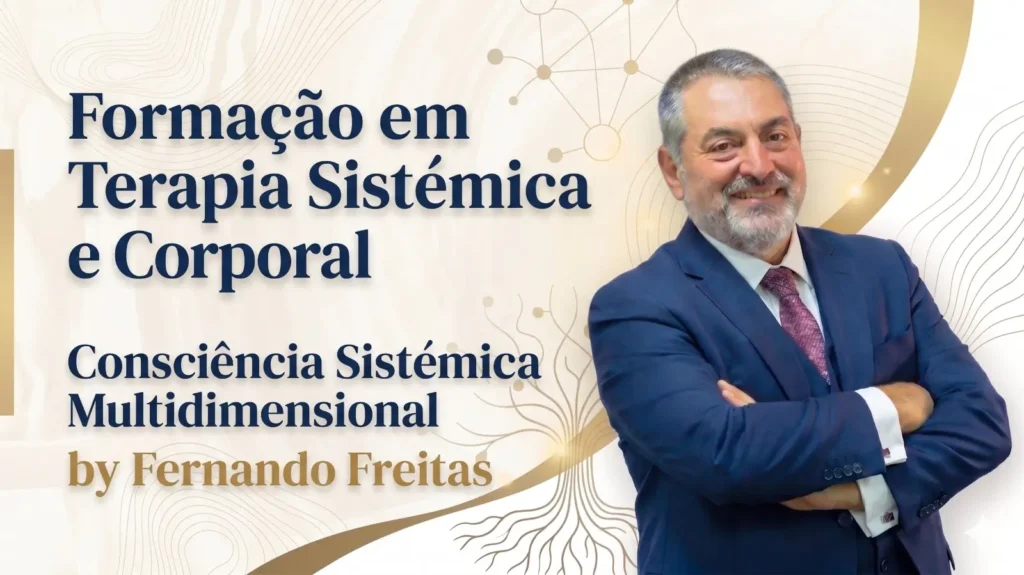
Fernando Freitas

With over 45 years of clinical experience, the Dr. Fernando Freitas He is a medical doctor graduated from the Paulista School of Medicine (UNIFESP), a gastrointestinal surgeon, a neo-Reichian body psychotherapist, a psychosomatic analyst, and a systemic family and organizational constellation facilitator.

He is a pioneer in the integration of medicine and systemic approaches and the creator of... Systemic Awareness in Brazil, having subsequently founded the IASC – International Academy of Systemic Consciousness.

His approach combines clinical depth, practical experience, and an integrated view of the human being, illness, relationships, and systems.

Mentoring

Carla Queiroz

A physician graduated from the Faculty of Medicine of Catanduva (FAMECA), specializing in gynecology and obstetrics, sexology, psychosomatic analysis, therapy, and systemic constellation facilitator.

Together with Dr. Fernando Freitas, he structured the Systemic Awareness Method, He founded IBRACS in Brazil and participated in the creation of IASC in Portugal.

Her expertise integrates medicine and systemic approaches, with a special focus on women's holistic health and a deep understanding of emotional and relational dynamics.

Training program

Axis 1 – Theoretical Video Lessons
Core Knowledge

  • The formation of the human being as a biological, emotional, and systemic process.
  • Emotional and bodily embryology
  • Influence of intrauterine emotions, maternal stress, and systemic context
  • Early bodily records and implicit memory
  • Neurobiological and psychosomatic bases of character organization
  • The body as the primary field of adaptation and survival.
  • Child development as a structuring axis of character
  • Oral phase: bonding, emotional nourishment, dependence, and security.
  • Anal phase: autonomy, boundaries, control, and self-affirmation.
  • Genital phase: identity, expression, fulfillment, and relationship with the world.
  • Interruptions in development and fixations
  • Relationship between unmet needs and adult functioning patterns
  • Trauma as a disruption of developmental continuity.
  • Body, emotional, and mental defense mechanisms
  • Formation of character traits as survival strategies.
  • Interaction between different character traits in the same individual.
  • Functional dimension of traits: resources, talents, and potential.
  • Dysfunctional dimension of traits: blockages, conflicts, and suffering.
  • From adaptive character to crystallized character.

Axis 2 – Live Online Classes
In-depth analysis of character traits.

  • An integrated view of the five character traits.
  • Character as a dynamic system, not as a label.
  • Body language, emotional intelligence, and relational awareness
  • Ethics and responsibility in the use of character diagnosis.
  • Developmental and systemic origin
  • Body and energy reading
  • Mental and emotional functioning
  • Functional dimension: creativity, vision and sensitivity
  • Dysfunctional dimension: withdrawal, dissociation, and fear of contact.
  • Originates from emotional attachment and dependence.
  • Body language and relational reading
  • Patterns of lack, expectation, and frustration
  • Functional dimension: empathy, communication and connection
  • Dysfunctional dimension: dependency, victimization, and emptiness.
  • It stems from a breach of trust and emotional betrayal.
  • Body language, posture, and presence
  • Relationship with power, control, and leadership
  • Functional dimension: direction, strategy and decision-making.
  • Dysfunctional dimension: manipulation, rigidity, and emotional disconnection.
  • Originating from the repression of expression and autonomy.
  • Body language and energy restraint
  • Relationship with guilt, submission, and passive resistance.
  • Functional dimension: resilience, consistency, and commitment.
  • Dysfunctional dimension: self-sabotage and chronic suffering
  • Originates from the demand for performance and recognition.
  • Body language, structure and tonicity
  • Relationship with perfectionism, competition, and image.
  • Functional dimension: achievement, efficiency, and focus.
  • Dysfunctional dimension: rigidity, anxiety, and emotional disconnection.
  • Combinations of traits in the same individual
  • Internal conflicts between different organizations of a certain nature.
  • Impacts on affective, family, and professional relationships.
  • Systemic reading of relational patterns
  • Paths to character integration and development.
  • Criteria for therapeutic progression
  • Body and systemic intervention strategies
  • The role of the professional in the transformation process.

Axis 3 - Practical Experiential Training

Objective: To develop practical competence in body language reading, diagnosis, and systemic intervention.

Contents of the in-person meetings
  • Intensive training in passive and active body language reading;
  • Observation of posture, breathing, muscle tone, and movement;
  • Practical identification of character traits;
  • Specific body exercises for each trait;
  • experiential and systemic dynamics;
  • real case studies;
  • Simulations of customer service, mediation, and group facilitation;
  • Integration between body, emotion, mind, and system.

Timeline

Module 1 – September 26 and 27, 2026
Start of training
Theoretical and scientific foundations that underpin systemic theories, main concepts, and dynamics of family constellations.

Module 2 – October 24 and 25, 2026
Fundamentals of Quantum Physics and Morphogenetic Fields — Types of Relationships and Human Evolution.

Module 3 – November 28 and 29, 2026
Systemic laws – life goals – family and professional.

December 2026

School break

Module 4 – January 30 and 31, 2027
Body psychotherapy — nonverbal language — systemic approach.

Module 5 – February 27 and 28, 2027
Romantic relationships and family — family dynamics.

Module 6 – March 27 and 28, 2027
Psychosomatics — the language of illness.

Module 7 – April 24 and 25, 2027
Systemic and organizational coaching — professional dynamics.

Module 8 – May 22nd and 23rd, 2027
Individual constellation with figurines.

Module 9 – June 26 and 27, 2027

Graduation
Group constellation and synthesis of learning.

Workload and supplementary structure

• 140 hours in person
• 225 hours of materials
• 62 hours of group mentoring
6 PM with Dr. Fernando
65 hours of reading and studying

It also includes
•Program Be More Aware
10 videos of practical family constellation exercises
• 10 videos with practical relationship exercises
• Q&A session with the instructor on the first Monday of each month.
• Weekly meetings with IASC mentors
• Printed and PDF course materials
• Access to recorded classes on the Mentara platform for 24 months.
• Integration into the IBRACS/IASC community

Investment

Early Bird – until 06/26/2026

Cash payment €3,492

Payment in 10 installments of €360

After 06/26/2026

Cash payment €3,600

Payment in 10 installments of €450

Special offer for couples

25% discount

Benefit for Mentara students

Cashback of €180

You will gain a skill that will make all the difference in the way you serve customers.

You can continue to treat only the symptoms — or you can choose training that allows you to see more deeply, understand the origin of the patterns, and intervene with much more clarity and effectiveness.

This is not just another training course.
It's a journey of personal and professional transformation for those who want to work with a higher level of awareness, precision, and depth.

Spaces are limited.

Frequently asked questions

Yes. At the end of the training, you receive dual certification for the IASC / IBRACS and by MENTARA, with the awarding of the title of Systemic and Body Therapist.

Not necessarily.
This training is designed for professionals in the fields of health, education, human development, justice, and organizational context—but also for people in career transition who wish to work in this area seriously and thoroughly.

Yes — with responsibility and an ethical framework.

You will be trained to:

  • identify character traits
  • recognizing emotional and relational patterns
  • to perform body and systemic reading

Always focused on deep understanding and appropriate intervention, and not in labeling people.

In-person meetings are an essential part of the training.

In case of absence:

  • You will have access to some of the theoretical content.
  • but the experiential and practical component is not entirely replaceable.

Attendance at all modules is strongly recommended.

Yes. The training includes:

  • monthly meetings with the trainer
  • weekly meetings with mentors
  • moments of supervision and clarification of doubts

Monitoring is continuous throughout the 9 months.

Yes. There are phased payment options:

  • up to 10 monthly payments
  • no need for immediate full payment

Yes. There are phased payment options:

  • up to 10 monthly payments
  • no need for immediate full payment

✔ This is for you if:

  • wants to understand human beings in depth
  • seeks to go beyond superficial techniques
  • is willing to grow personally and professionally
  • wants to develop a differentiated diagnostic capacity

❌ Not for you if:

  • looking for quick or superficial solutions
  • They just want "another certification".“
  • is not available for personal involvement in the process.
en_USEnglish